

Opened in 2021, our Kesselhaus is a 1600sqm craft beer behemoth. A brewhouse, bar, beer garden and event space in the heart of Wedding - every...
CHRYSALIS Symposium. Sound, Perception, and More-than-Human Ecologies
Sat, 28 Nov 2026 10:30-19:30
Sat, 28 Nov 2026
10:30-19:30
CHRYSALIS Symposium. Sound, Perception, and More-than-Human Ecologies
Artists (and other speakers) KEYNOTE: Dr Marietta Radomska (Philosopher, Professor of Environmental Humanities, Linköping University, SE)
PANEL SPEAKERS: Dr Elisabeth Luggauer (Urban and Environmental Anthropologist, Institute for European Ethnology, Humboldt-Universität zu Berlin); Elise Malsch-Fröhlich (Environmental Scientist, Leibniz Institute of Freshwater Ecology and Inland Fisheries (IGB), Berlin); Helena Nikonole (Artist and Researcher, Berlin); Julius Holtz (Sound artist and composer, Berlin); Dr Marcus Maeder (Artist and Scientist, Professor at the Lucerne University of Applied Sciences and Arts, CH); Dr Margherita Pevere (Artist and Researcher, Berlin); Dr Matthias Rillig (Professor for the Ecology of Plants, Institute of Biology, Freie Universität Berlin); Dr Salomé Voegelin (Professor of Sound, University of the Arts London, UK, and Bern Academy of the Arts, CH); Dr Shintaro Miyazaki (Juniorprofessor for Digital Media and Computation, Humboldt-Universität zu Berlin).
What if listening could transform how we understand ecological relations? How do sound and vibration intervene in living systems? And how might neural feedback reshape the relationship between bodies and computational environments? Emerging from Art Laboratory Berlin's CHRYSALIS. ARTISTS IN LABS programme (2025–2026), the 1-day symposium (on-site with livestream) builds on four artist-scientist collaborations exploring microbial ecologies and environmental change, alongside neuroscience and the computational mediation of perception. Art Laboratory Berlin will bring together international contributions from artistic research, philosophy, sound studies, media theory, computational studies, environmental humanities, urban and multispecies anthropology, as well as freshwater and soil ecology. Across these perspectives, the symposium asks how experimental practices make otherwise imperceptible processes available to experience – and how the instruments through which we observe and listen also shape what can become known. At stake are the relations between perception and intervention and the responsibilities of working with living systems. Finally, the symposium will debate current research connected to cooperative relationships between humans, more-than-humans, technologies, and their environments.
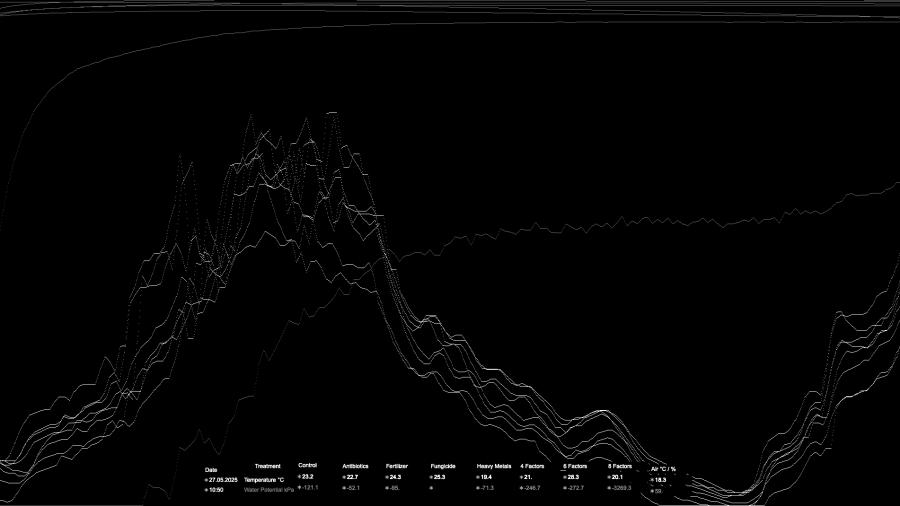
Marcus Maeder: Change Factors, 2026