
Magic and Tragic

Magic and Tragic
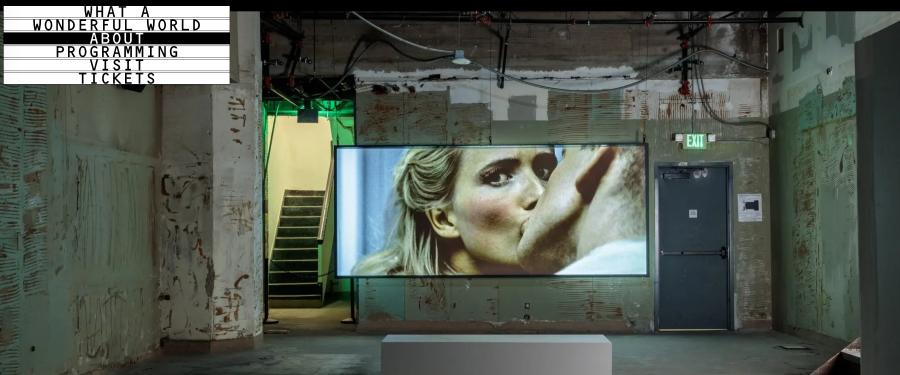
“What a Wonderful World: An Audiovisual Poem,” the first extensive US presentation of the Julia Stoschek Collection, edited by Udo Kittelmann, opened in the legendary Variety Arts Theater, downtown Los Angeles, last month, and I am not one to not get off my high horse for access to a cool location and free popcorn. If the Nazi glove doesn't fit! My bad, stage two party follower. Non-ideologically complacent. They were manufacturing not guns, after all, but parts for guns.
The show’s title is taken from the Louis Armstrong song from 1967; it was used ironically back then as well, but naming anything in this world right now "wonderful" feels stone cold. Kittelmann, who likes to refer to himself as an editor, not a curator, says that he has a particular interest in works that are “both magic and tragic" and doesn’t appear to be ironic. Perhaps he finds a certain hedonistic complexity in depictions of violence?
Stoschek has been trying to get her collection to Los Angeles for years; the five-story Venetian-style theater has stood empty, more or less, since the 1990s.
I eat most of my unsalted popcorn (unsalted popcorn is a crime!), squirming through Arthur Jafa's debut screening of a "Special Video Compilation" (someone gave a lot of thought to that title), watching Michael Jackson footage: as a child wonder and an adult, dancing, singing, and refusing to answer questions about the sexual abuse allegations. Do we really still need this did-he-or-didn't-he tension? Is there even tension still? He did it. This happened. (I had to start yelling at a birthday party the other day when the moms were off worrying about how Iran is going to attack California: WE are attacking THEM!)
The historical building was commissioned by the Friday Morning Club, a social and political group for women, and opened on May 5, 1924. Charlie Chaplin was there! I bet Cesar Chavez, social rights activist, union leader, and rapist, was here at some point, too. You really can't turn a history page these days without a child's or women's abuser's name. Maybe that is why this show feels like the Who's Who of rape apologists? Allegedly. The whole remaining König roster has work here. I shift through the rooms in growing discomfort. I don't think Berlin is far enough away from LA to pull this shit off, but here we are. Time and careful editing, it seems, wash off all crimes. Magic and tragic.
Ana Mendieta’s Anima, Silueta de Cohetes (Firework Piece) (1976) seems to be the cherry on the wife-killing cake. Is this a cry for help? Maybe Julia has some stories to share as well.
The building’s history of hedonism continued as a vaudeville, cabaret, and comedy hub when it was purchased in 1977 by the Society for the Preservation of the Variety Arts. Some locals (like participating artist Doug Aitkins) remember going to some legendary punk parties here in the 80s. Some don't remember anything.
Mendieta's work features an effigy of a female body, its outline lit out of fireworks; she films the burning silhouette until, puff, it extinguishes.
Where does the truth go after it is uncovered, I wonder?